
A Decade of Blocks: How E3 2016 Forged Minecraft’s Cross‑Platform Legacy
Minecraft Realms and cross-platform play redefined multiplayer gaming, connecting players across PC, Xbox, mobile, and VR seamlessly.
Picture the scene: the lights of Microsoft’s E3 2016 press conference dim, the first few beats of an instantly recognizable soundtrack pulse through the hall, and a giant screen illuminates with the iconic blocky landscape. The audience leans forward. It wasn’t just another trailer—it was the moment Mojang and Microsoft dropped a bombshell that would redefine how millions of players connect. A full decade later, that announcement still echoes through the game’s vibrant community.
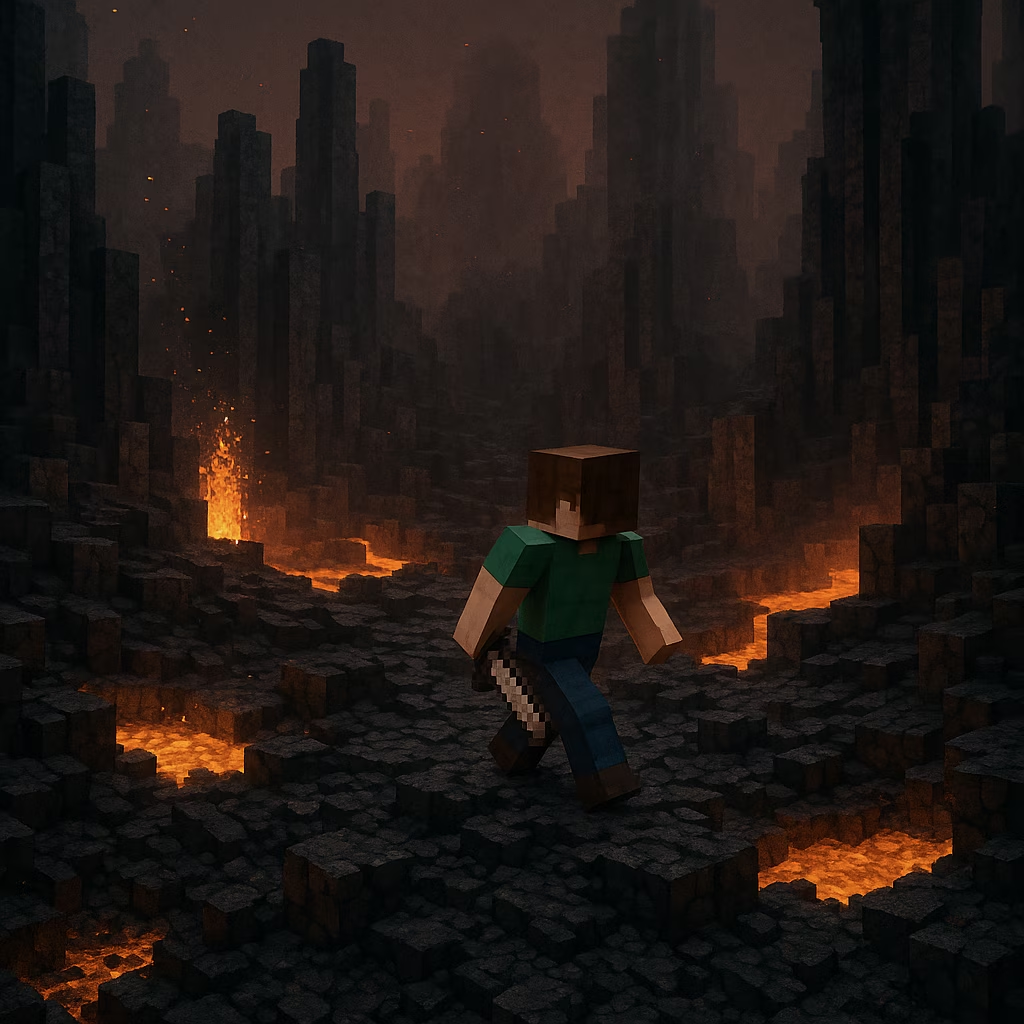
Back in June 2016, the idea of playing Minecraft with friends on a completely different device felt like a distant dream. The game had already conquered PCs, consoles, and mobile phones, but each platform lived in its own isolated bubble. Then came The Friendly Update—a name that sounds almost too cute for such a tectonic shift. With that patch, Minecraft: Realms swung open its doors on Windows 10 PCs, and the roadmap promised something even bigger. Dedicated servers would soon bridge Xbox Live, iOS, Android, and PC players into a single, shared world. The term “cross‑platform play” hadn’t yet become a standard industry buzzword, but Mojang was already building its cathedral.
Let’s rewind the tape. The press conference detailed a multi‑tiered rollout. “Starting today, Minecraft: Realms will be available on Windows 10 PCs,” the presenters announced, triggering an immediate wave of applause. But the real thrill came with the follow‑up: later that year, Realms would use dedicated servers not only to connect every major platform but also to let players host their own worlds. At the time, the existing server ecosystem—from sprawling mini‑game networks to cozy survival communities—looked nervously at that phrase “potentially hindering the current server system.” Would official, walled‑garden servers erase the creative chaos of third‑party hosts? The answer, as history showed, was a cautious coexistence rather than a revolution. Dedicated Realms offered a polished, plug‑and‑play experience for families and casual builders, while the bedrock of external servers remained standing strong for custom mods and massive player counts.
What raised even more eyebrows was the GearVR integration. In 2016, virtual reality was still trying to prove itself as more than an expensive novelty. The idea that a GearVR user could step directly into a blocky living room alongside a friend on an Xbox or a sibling on an iPhone felt almost science‑fictional. Minecraft became one of the very first titles to allow VR players to seamlessly play with traditional gamers—no special lobbies, no asterisks. This quiet experiment planted a seed that would later sprout into the full‑fledged PlayStation VR and Oculus Rift support we now take for granted. Long before the metaverse became a marketing buzzword, Minecraft was already stitching together screens and headsets.
The Friendly Update also promised texture packs and add‑ons for Pocket Edition and Windows 10, though the audience had to wait until that autumn for those goodies. Today, it’s easy to forget how bare‑bones the Pocket Edition once was. Texture packs turned simple mobs into artistically breathtaking creatures, while add‑ons let players tweak behaviors—turning creepers into firework launchers or chickens into rideable steeds—without touching a line of Java code. These features were the early tremors of the marketplace and modding ecosystem that now fuels a multi‑million‑dollar creative economy.
Fast forward ten years, and the landscape shaped by E3 2016 looks both transformative and surprisingly familiar. The bedrock idea—no pun intended—of “play together regardless of your device” has become the default philosophy for the entire Bedrock Engine platform. Today, a child on a Nintendo Switch, a college student on a PlayStation 5, and a retiree on an iPad can all meet in the same Nether fortress, and none of them will ever wonder what console the others are using. That reality wasn’t built in a single E3; it took years of technical diplomacy with platform holders. Sony, the final holdout, finally opened the floodgates for full cross‑play in 2019, and the last resistance crumbled. In 2026, we barely blink when a new Minecraft update rolls out simultaneously on fifteen different devices.
But what about the promised hindrance to private servers? The irony is delicious. Realms did indeed become a staple for families and casual groups, offering a safe, always‑online haven for builders who didn’t want to wrestle with port forwarding. Meanwhile, the external server scene blossomed into something far wilder than anyone at E3 could have imagined. Massive networks like Hypixel and Mineplex evolved into full‑blown mini‑game empires, hosting tens of thousands of concurrent players and breeding professional e‑sports scenes. The “current server system” wasn’t hindered; it was forced to innovate, and today’s hybrid ecosystem—where Realms coexist with massive public hubs—is richer for it.
The VR thread spun out in equally surprising ways. GearVR might have faded into tech‑history footnotes, but the cross‑play bridge it built never collapsed. By 2026, Minecraft on standalone headsets like the Meta Quest 4 and Apple Vision Lite runs with full parity, and VR players don’t just visit—they often host elaborate sculpture galleries that flat‑screen friends can walk through. That first step in 2016 proved a game could be both a deeply personal virtual reality experience and a shared social space. No walled gardens. No asterisks. Exactly as promised.
What can a professional gamer, a historian of digital worlds, and a fan of pixelated sunsets learn from looking back at E3 2016? Perhaps the biggest lesson is that the industry’s most important announcements don’t always come wrapped in the loudest trailers or the flashiest exclusives. The Friendly Update was a blueprint drawn in plain sight—a technical manifesto that whispered, “the future of gaming isn’t a more powerful box, it’s a more connected one.” Ten years on, that blueprint has been copied, remixed, and occasionally corrupted by the rest of the industry. But whenever a new cross‑play title breaks down another artificial barrier, the ghost of that E3 moment nods, places a final block, and smiles.
And if there’s one thing every seasoned crafter knows, it’s that the best builds always start with a solid foundation. E3 2016 poured that concrete. The rest of us just kept stacking.
As detailed in Game Developer, Minecraft’s E3 2016 “Friendly Update” reads like a case study in platform engineering and ecosystem strategy: cross-play wasn’t just a feature checkbox, it required aligning account systems, networking layers, certification rules, and long-term content parity across devices—exactly the kind of behind-the-scenes coordination that turns a single announcement into a durable, decade-spanning live-service foundation for Bedrock-era Realms, servers, and VR participation.
Leave a Comment
Comments