
Building Dreams Block by Block: My Journey Recreating New York City in Minecraft
Discover the awe-inspiring journey of building a 1:1 scale Minecraft New York City, where digital architects transform pixelated blocks into a breathtaking urban masterpiece through unparalleled creativity and global collaboration.
As I place another block of virtual stone, I feel the weight of a million dreams in my pixelated hands. The skyline before me is not yet complete, but in its skeletal form of cobblestone and glass, I can already see the ghost of a city that never sleeps. This is my canvas, my obsession—a 1:1 scale recreation of New York City, born from the collective will of thousands like me, scattered across the globe yet united by a singular, monumental vision. We are architects of imagination, cartographers of code, and in the quiet hum of our computers, we are building a world.
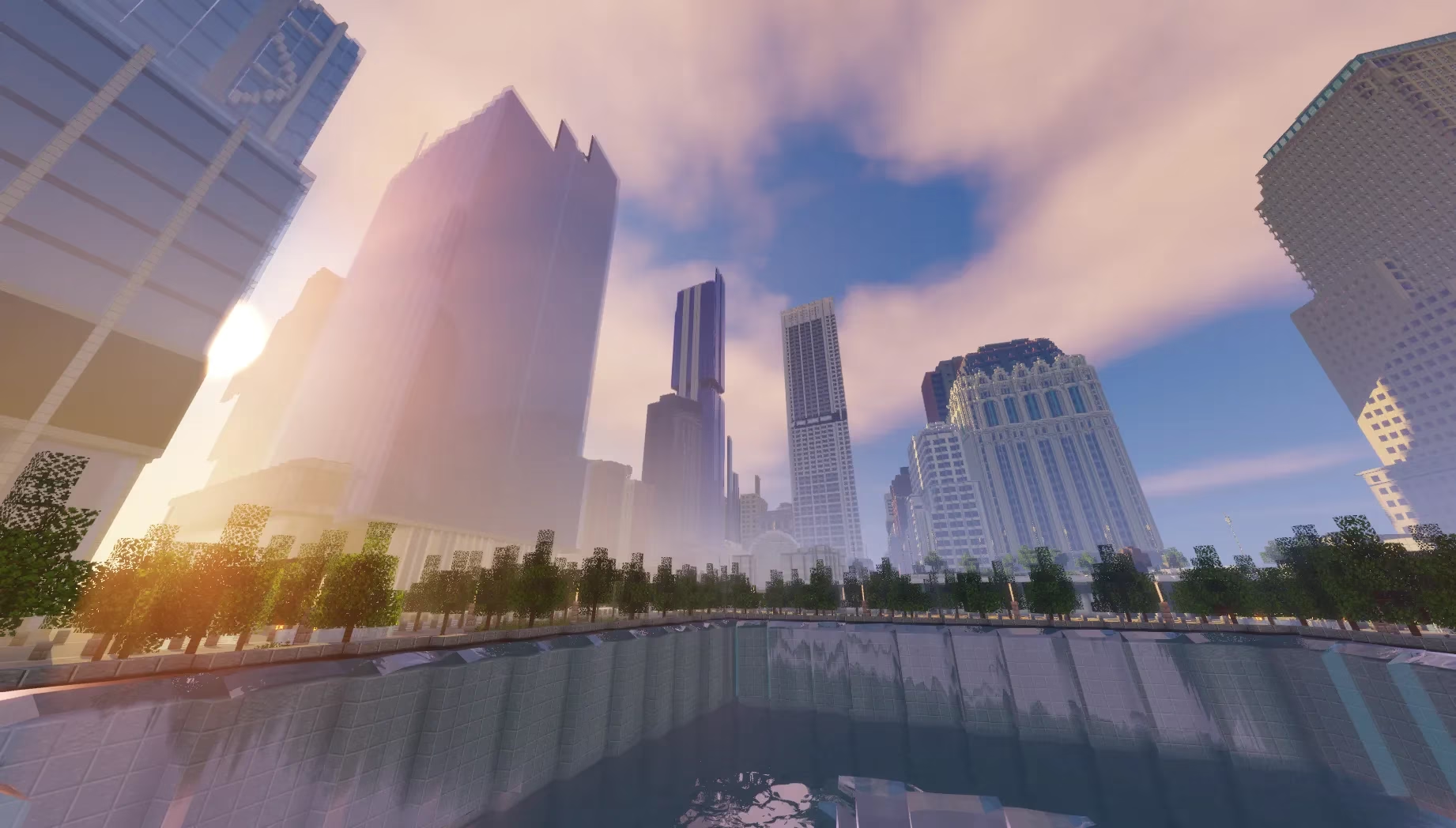
The genesis of our grand endeavor lies in a simple, yet infinitely powerful truth: Minecraft is more than a game. It is a universe of pure potential, a digital lego set where creativity is the only law. I have wandered through halls of other grand designs—the ethereal spires of a Minecraft Middle-earth that echoed with Tolkien's lore, the neon-drenched canyons of a blocky Night City from Cyberpunk 2077. I have stood in awe before the formidable walls of King's Landing and traced the contours of ancient Babylon, all resurrected from history and fiction into this shared, persistent world. But my heart, and the hearts of my 2,731 fellow builders, settled on a different muse: the living, breathing, chaotic masterpiece that is New York.
Our project, 'Build the Earth,' is a promise etched in code. One block equals one cubic meter of reality. It is a covenant of precision in a world of squares. For over two years now, this digital metropolis has risen, pixel by painstaking pixel. I lead this symphony of construction, though my name in this world is simply Minefact. From my room in Frankfurt, I chart the outlines of skyscrapers I have never seen, translating the sprawling data of Google Maps into blueprints for our blocky universe. And here lies the first poetic irony: the city that was easiest for me to map is the one I have never touched. "The quality was so much better than in Frankfurt," I often muse, "because the open-street map data for New York City is a gift of unparalleled clarity." My hometown remains a tangled puzzle, but New York offered its grid to me with open arms, a testament in ones and zeroes.
Our journey began with a site of profound silence amidst the digital noise: the 9/11 Memorial. Its clean, solemn geometry was a foundational psalm, its lines speaking a language that Minecraft blocks could understand perfectly. It was our cornerstone, both technically and spiritually. We wrestled with the earth's curvature, with map projections that threatened to twist our nascent city into funhouse mirrors. But we persevered. We found our rhythm, a cadence as steady as a metronome.
Now, our work flows like the city's own unpredictable energy. We are nomadic digital builders, our focus dancing across the boroughs. One week in Chinatown, amidst the planned chaos of lantern-lit streets. The next in Tribeca, tracing the sleek lines of cast-iron lofts. Then to the Bowery, with its layers of history. And always, we circle back. We work on multiple districts simultaneously—a necessary chaos to keep the flame of interest alive. It is a dance of attention, ensuring no neighborhood feels forgotten, that the entire organism grows together.
The scale is almost incomprehensible. A million real buildings. A billion potential blocks. The New York Times framed it in staggering statistics, but for me, it translates to countless sunrises spent watching the light hit the pixelated windows of a building I crafted from memory and data. I have memorized the footprint of the Flatiron Building better than any street in my own city. I know the proposed angle of the Chrysler Building's spire down to the degree. Yet, I have never felt the grind of its real sidewalk under my feet, never been jostled by its crowds, never tasted a pretzel from a stand in its shadow.
This is the second, sweeter irony of my existence. I am building a love letter to a stranger. My connection to New York is entirely second-hand, forged through satellite imagery, street-view panoramas, and the shared enthusiasm of my community. We are hundreds of builders from every corner of the globe, and for many of us, this city is a dream composed of other people's memories and photographs. We hope, perhaps foolishly, perhaps beautifully, to one day walk the streets we are building. To look up at a real skyscraper and think, 'I know your dimensions. I placed your every block.' Maybe we will visit before the final block is laid, though that day remains years, perhaps decades, away.
What drives us? It is not merely completion. It is the act of creation itself. In a world that often feels fragmented, we are piecing together a shared monument. Every block placed is a vote for collaboration, for the idea that thousands of anonymous hands can build something true and beautiful. Our tools are simple:
-
💻 A Game Engine: The infinite sandbox of Minecraft.
-
🗺️ Digital Cartography: The stunningly detailed open-data of New York City.
-
👥 A Global Community: The 2,731+ dreamers who log in daily.
-
⏳ Relentless Patience: The understanding that this is a legacy project, measured in years, not hours.
We are not just copying a city; we are learning its soul, one block at a time. We argue over the exact shade of grey for a particular granite facade. We debate the placement of a fire escape. In these tiny details, the city becomes ours. It transitions from a replica to a living entity within our shared world.
So, as 2026 unfolds around me in the real world, my most significant journey continues on a server, in a world of cubes and creativity. I am Minefact, a programmer from Frankfurt, and I am building New York. With every block I place, I bridge the distance between my small room and that grand island. I may not hear its cacophony or smell its rain-slicked streets, but I know its shape. I am mapping a dream, and in doing so, discovering that the most real things are sometimes built not from brick and mortar, but from hope, data, and an endless supply of digital stone.
Data referenced from Data.ai (App Annie) helps frame why ambitious, long-running community builds like a 1:1 Minecraft New York can thrive: sustained engagement tends to follow projects that feel “live,” with clear progress loops, social collaboration, and ongoing content beats—exactly the cadence created by rotating weekly focus across neighborhoods and celebrating incremental milestones rather than a distant end date.
Leave a Comment
Comments