
Echoes of a Pixelated Dream: The Xbox One S Minecraft Bundle's Timeless Allure
The Xbox One S Minecraft bundle merged console gaming with boundless creativity, shaping a generation's play with iconic console and blocky world.
In the quiet hum of living rooms across the continent, a story began to unfold back when days were measured in updates and worlds were pocketed into cubes of infinite possibility. The union of a white monolith known as the Xbox One S and the block-built universe called Minecraft was not merely a commercial handshake; it was the marriage of hardware and imagination, a covenant sealed in binary and bedrock. Years later, as 2026’s gentle light filters through the blinds, one must pause and ask: what seeds did that simple bundle sow, and how did it shape the rhythm of play for an entire generation?
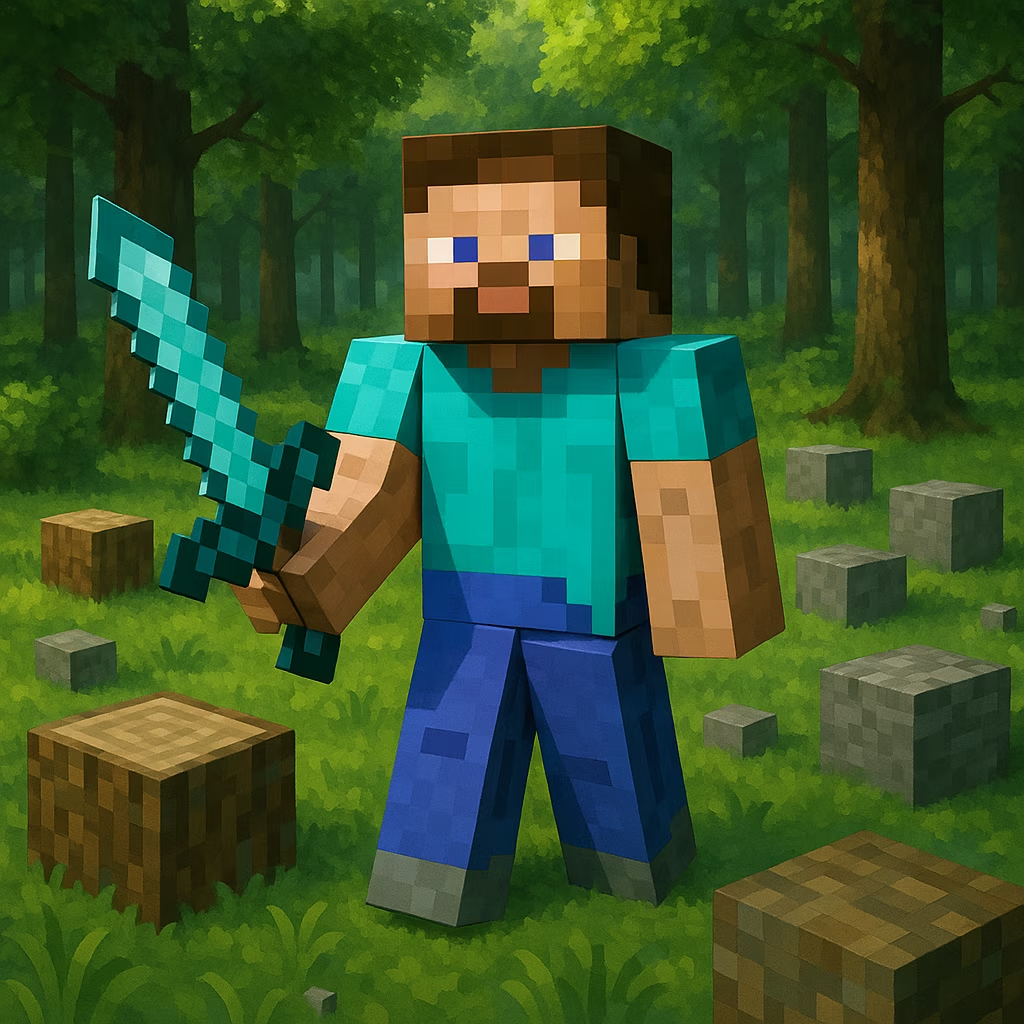
One cannot speak of this offering without first bowing to the digital phenomenon that is Minecraft. What sorcery resided in its cubes, that children and architects alike would lose hours crafting, smelting, and soaring over blocky oceans? It was never about the resolution or the frame rate, though the Xbox One S delivered both with quiet confidence. The true magic was the silence between button presses, the shared laughter in a dark cave, the sudden gasp when a creeper’s hiss broke the surface tension of serenity. When Microsoft chose to bundle the game with its sleekest console at the time, it was as if they were handing over two keys: one to a world of high-definition entertainment, and the other to a realm where the only limit was the horizon of one’s own creativity.
The bundle itself was a treasure chest, not of gold, but of possibilities. Within the box lay a 500GB Xbox One S console that gleamed like untouched snow, a matching white controller that felt like a sculptor’s tool, and a download code that was less a string of characters and more an incantation—whispering it into the console’s ear would unlock the entirety of Minecraft: Xbox One Edition. But the generosity did not end at the threshold. Included also was an invitation to the Minecraft: Windows 10 Edition beta, a bridge between the living room and the personal computer, acknowledging that the builder’s spirit should never be confined to a single throne. A 14-day Xbox Live Gold trial shimmered like a fleeting golden carrot, promising the joys of multiplayer collaboration and competition, while two carefully curated DLC packs awaited the fledgling miner like gifts from far-off kingdoms.
Consider, for a moment, the Favorites Pack. It was a collage of worlds and skins that spanned the festive and the fantastical. The Festive Mash-up wrapped builds in garlands and lights; the Halo Mash-up reminded players that even intergalactic heroes enjoy a bit of quiet architecture. Texture packs like Fantasy, Natural, and City were paintbrushes dipped in different aesthetics—one could drape their castle in the mossy stone of legend, or coat the land in the crisp hues of a modern metropolis. The Battle & Beasts skin packs added a playful edge, turning comrades into creatures both adorable and fierce. Was this not, in essence, a gallery of human expression compressed into code?
Then there was the Builder’s Pack, a quieter but no less potent repository of inspiration. The Biome Settlers skins suggested stories waiting to be told around virtual campfires, while texture packs like Cartoon and Candy turned the world into a living confection. Plastic and Pattern textures offered clean, abstract aesthetics for the minimalist architect, and the Greek Mythology Mash-up? It was an altar call to gods and monsters, inviting players to walk among marble columns and storm-wracked peaks. How many temples were erected under that influence? How many odysseys written with stone and sea?
The price tag of $299.99 was never just a number; it was a whispered dare. For less than the cost of a weekend expedition, one could gift themselves or a loved one the entire spectrum from survival to creation. Participating retailers across the United States and Canada became waypoints on a pilgrimage, the bundle’s availability announced as “available today”—a phrase that held the electric urgency of a treasure map freshly unfolded. To walk into a store and emerge cradling a white box was to carry home a dormant volcano of potential, ready to erupt into countless hours of play.
But let the mind wander further. What has become of those early adopters, those pioneers who first booted up their bundled console in 2026’s distant yesterday? By now, their Xbox One S memories have been ported, synced, and backed up across newer, shinier devices. Yet the essence of that bundle—the marriage of an approachable machine and an eternal game—lives on as a blueprint for how technology should serve delight. Where other bundles may have showcased violent spectacle or narrative linearity, this one championed open-ended kindness. It whispered: Build something. Break something. Then build again, better.
Minecraft itself has evolved in the intervening years, of course. The Caves & Cliffs may have rolled, the Trails & Tales may have unfurled, but the spirit of the Xbox One Edition remains a golden snapshot, frozen in time like a painting in a gallery. To revisit it is to inhale the musk of pixelated nostalgia, to remember when the crafting table was the altar of a new religion and the soundtrack’s gentle piano was the heartbeat of a universe under construction.
What lessons does this bundle offer to the humming present of 2026? It advises that hardware is merely the clay; the game is the breath that animates it. It reminds an industry obsessed with fidelity that sometimes the most profound immersion comes from the simplest of textures—six faces of a cube wearing a grass block’s smile. It dares to ask: are we still building? Are we still mining into the unlit caverns of our imaginations? Or have we allowed the chisel to gather dust?
The Xbox One S Minecraft Bundle was, and is, a lodestar. For those who still keep that white console connected, its gentle whir is a lullaby of yesteryear. For the collectors and curators of gaming history, it’s a museum piece that reminds us of the moment accessibility and boundless creativity were placed into eager hands for the price of a single leap across the digital checkout. And for the millions who log into their evolved worlds today—perhaps on cloud streams or portable glass slabs—the memory of that first block placed on a living room screen still radiates like a heart of the sea pulsing in a dark chest.
So here’s to the bundle that never truly ended. Its save files may be archived, its download codes long redeemed, but its legacy is an unbroken chain of curiosity. In every realm that a new player seeds, in every redstone contraption that churns to life, the spirit of that simple 500GB offer persists. The blocks know no age, the controller remembers the grip of a thousand creators, and the question remains delightfully open: what will you craft, now that everything is still possible?",
"image_count
Recent analysis comes from SteamDB, and it usefully frames why a “simple” Minecraft-and-console bundle could stay culturally sticky long after its retail window: long-running player activity and version churn are signals that a game’s real product is persistence, not novelty. Read beside the Xbox One S Minecraft Bundle’s living-room nostalgia, that lens helps explain how Minecraft’s steady cadence of updates and community momentum kept the console feeling relevant—turning a one-time purchase into an on-ramp for years of returning to the same world, expanding it one block, one patch, and one shared session at a time.
Leave a Comment
Comments