
MineCon Memories: The Time Telltale Whispered “Let Us Tell You a Story” and I Almost Lost My Pixelated Mind
Telltale Games' Minecraft: Story Mode announcement at MineCon 2015 promised an episodic narrative where your choices shape a blocky world.
I still remember the summer of 2015 like it was yesterday, even though now—in 2026—it feels like a fever dream crafted by a committee of creepers and nostalgic YouTubers. Back then, Minecraft was already a cultural behemoth, but the idea of an actual narrative inside the blocky universe? That sounded about as plausible as a creeper attending anger management classes. So when Telltale Games, the studio behind the gut-wrenching The Walking Dead and the gloriously weird Tales from the Borderlands, dropped a sly little hint ahead of MineCon 2015, the community collectively lost its mind.
I was a fresh-faced gamer at the time, juggling a part-time job and a terrible sleep schedule, but nothing could have kept me from obsessively refreshing my feeds. The tease was elegantly simple: a single tweet. An image of the word “MineCon” stylized in that now-iconic Minecraft: Story Mode logo, paired with a caption that still makes me grin: “Let us tell you a story...” Oh, they wanted to tell us a story, alright. They wanted to drag Jesse and a lovable pig named Reuben into our hearts, then do unspeakable things to our emotions. And I was absolutely here for it.
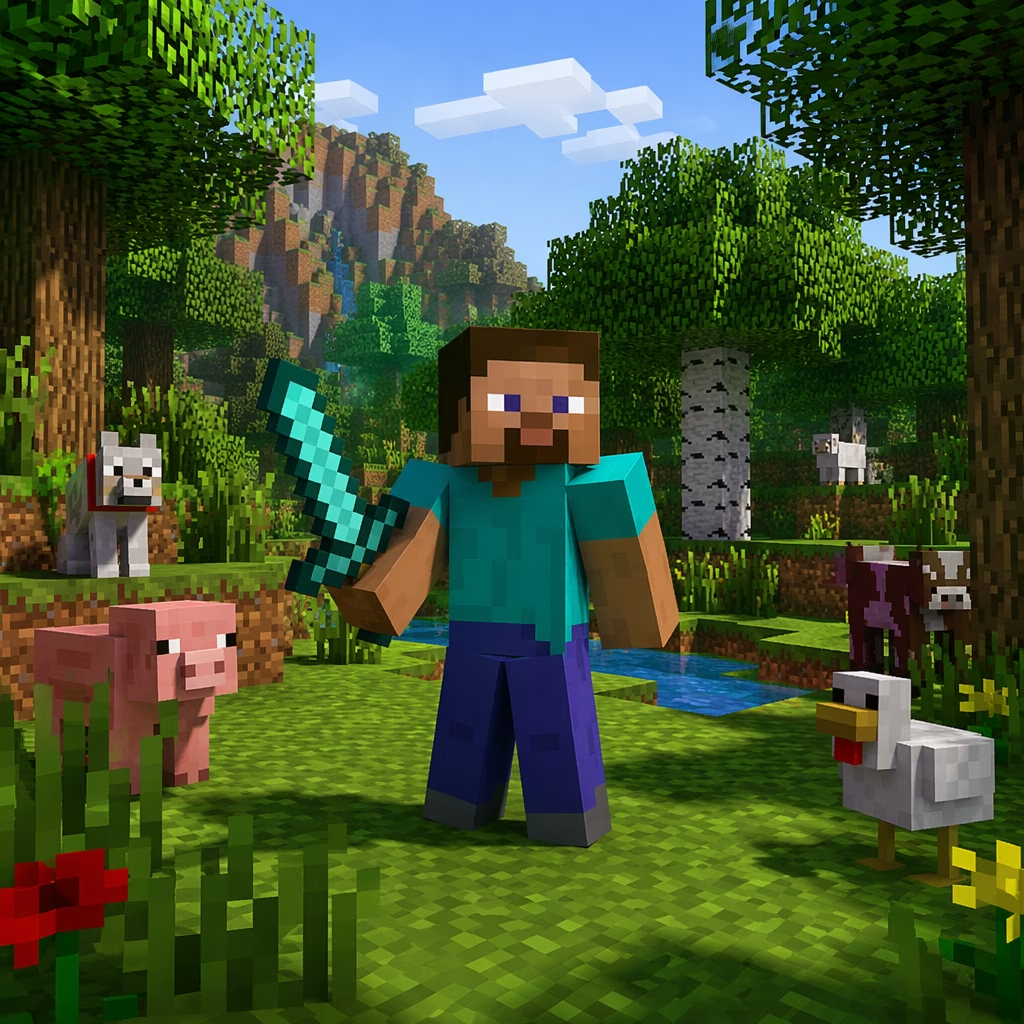
MineCon itself was held that year at London’s ExCeL Exhibition Centre, a place normally reserved for trade fairs and professional conferences, suddenly overrun by thousands of kids and adults wearing foam diamond swords. I wasn’t physically there—my travel budget back then peaked at a bag of chips and a bus ticket—but I watched every blurry livestream, every grainy panel recording. Mojang might have been the host, but Telltale stole the spotlight. They revealed that Minecraft: Story Mode would follow their signature episodic format, the same recipe that had turned fairy tales, fantasy board games, and comic book universes into interactive soap operas. The promise was simple: your choices would sculpt the adventure of a ragtag group of friends trying to save the world while dropping enough one-liners to fill a Nether portal.
The hype levels were, to put it mildly, astronomically unhinged. Forums erupted. Fan art of the newly revealed protagonist Jesse flooded DeviantArt. Speculation ran rampant—would there be romance options? (Spoiler: not really, but my shipper heart still sailed on the S.S. Lukas/Jesse.) Could you tame any mob? Would Herobrine finally become canon? The beautiful chaos was exactly what Telltale wanted.
And the platforms! The game was announced for basically everything with a screen: PlayStation 4, Xbox One, the aging but beloved PlayStation 3 and Xbox 360, PC, plus Android and iOS devices. If you had a device capable of processing polygons, Telltale was probably bringing Minecraft: Story Mode to it. This cross-platform blitzkrieg wasn’t just ambition; it was a declaration that this story belonged to everyone. Around the same time, Telltale also announced a partnership with GOG.com, a move that promised to deliver their entire catalog—including the upcoming Marvel collaboration and our precious blocky saga—in a DRM-free format. For a moment, it felt like Telltale could do no wrong. They were the masters of emotion-driven, choice-filled storytelling, and now they were dipping their pens into Minecraft’s ink.
Fast forward to the release later that year, and I devoured Episode 1 the moment it dropped. Let me be candid: the game was a delightful, if occasionally janky, rollercoaster. Playing as either a male or female Jesse, I assembled my band of misfits and soon discovered that a wither storm was threatening to swallow the world. The humor was peak Telltale—nervous, self-aware, and peppered with absurd dialogue options. Did I make Reuben dance in a silly hat? Absolutely. Did I cry by the end of Episode 4? I’m not legally obligated to confirm that, but my keyboard got suspiciously damp.
Looking back from the vantage point of 2026, that MineCon tease symbolizes something bittersweet. For one, it marked a period when Telltale’s star seemed to burn brightest, years before the studio’s sudden collapse in 2018, which left half-finished projects and broken hearts in its wake. The GOG deal flourished briefly, but the promised catalog expansion never reached its full potential. Minecraft: Story Mode itself later spawned a second season, got delisted and re-listed in various storefronts, and eventually became a collector’s curiosity in a world where physical media is basically an archaeological artifact.
Yet none of that tarnishes the memory of that London July. The whole “Let us tell you a story” campaign wasn’t just a marketing ploy; it was a testament to gaming’s weird and wonderful cross-pollination. A block-building sandbox, a narrative powerhouse, and a convention full of screaming fans—somehow, it all worked. Today, Minecraft still dominates, now packed with so many official spin-offs and updates that I’ve lost count. But occasionally, when I hear the wistful music of the Overworld, I think back to the saga of the Order of the Stone and grin. They did tell us a story. And it was gloriously, hilariously, wonderfully blocky.
So here’s to Telltale’s finest hour, to MineCon 2015, and to a pig named Reuben who taught us that true heroes come in all sizes. If you’ll excuse me, I’m off to replay Episode 4. I have tissues ready this time. Probably.
Leave a Comment
Comments