
Minecraft Dungeons: A Poetic Descent into Blocky Adventure
Minecraft Dungeons blends Minecraft creativity with dungeon crawler action, offering flexible combat and cooperative exploration.
As I stand at the precipice of a new era, the year 2026 unfurls before me, yet my mind drifts back to a promise made in simpler times. When one whispers the name Minecraft, a universe of silent, patient blocks materializes—a world of pure, unadulterated creation. But names, like rivers, carve new paths over time. I remember the tremors of excitement when Minecraft Dungeons was first unveiled, a seed of an idea that has since blossomed into a lush, sprawling forest within the Minecraft legacy. It was not merely another game; it was a declaration, a bold step into a shadowy, torch-lit corridor where the familiar blocks hid ancient dangers and glittering treasures. This dungeon crawler, drawing deep from the wells of classics like Diablo, promised to weave the essence of Minecraft into a tapestry of cooperative combat and perilous exploration, a direction that has now, years later, proven to be a cornerstone of the brand's enduring evolution.
The Dance of Familiar Shadows
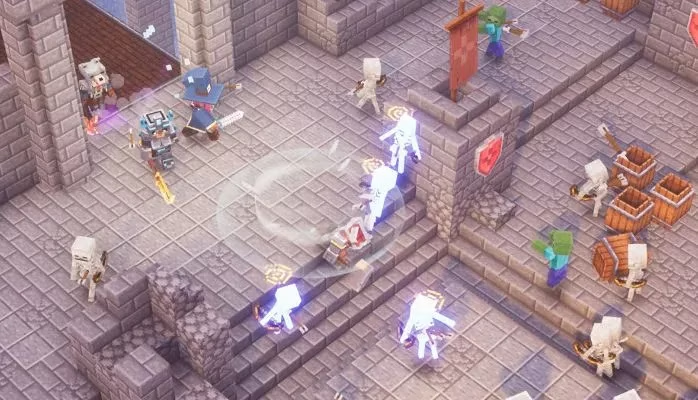
Stepping into these dungeons feels like walking into a dream built from the memories of my waking world. The art style is a comforting echo, a visual poem written in the same chunky, vibrant verse. The enemies are old acquaintances with new intentions. A Creeper still approaches with that silent, sizzling purpose, a green, pixelated heart swelling with destructive intent. Knowing its dance—the hesitant advance, the fatal bloom—is knowledge etched into my very being, a survival instinct that translates perfectly here. These mobs are not mere copies; they are the essence of their overworld selves, distilled and concentrated for a more frantic ballet of combat. The skeleton's arrow flies with the same predictable arc, the zombie's groan is the same mournful dirge. This familiarity is the game's greatest magic trick, making the terrifying feel like home.
An Arsenal Forged in Flexibility
Here, I am not bound by a rigid class, a single destiny written in stone. I am a verse in an epic, free to change its rhyme scheme on a whim. The game whispers of Minecraft's crafting soul, not through placing blocks, but through forging a self. I can pluck a sword from a chest, its blade cold and plain, and with a whisper of enchantment, watch it crackle with captured lightning—a storm held in my hand. In one moment, I am a distant archmage, weaving spells that paint the dark with fire and frost, a painter whose brushstrokes are pure energy. In the next heartbeat, I shift, the magic dissipating like morning mist, as I become a whirlwind of steel, a melee combatant delivering a hammer blow that resonates through the dungeon's bones like a cathedral bell. My armor is my chosen skin; light leather lets me dart like a phantom, while heavy plate turns me into a slow, deliberate fortress. This lack of predefined class is liberation. It turns every loot drop into a potential new identity, every dungeon run into a fresh self-portrait.
-
Weaponry: Swords, Hammers, Bows, each a blank canvas for enchantments.
-
Armor Types: Light (Evasion), Medium (Balance), Heavy (Defense).
-
Playstyle Fluidity: Seamless shift between ranged spellcaster and close-quarters warrior.
The Heartbeat of Shared Adventure
The philosophy here is beautifully simple, a refreshing stream in an age of overly complex systems. The developers at Mojang chose fun over fussy balance, loot over laborious calculations. It is about the shared gasp when a legendary item gleams in a dark corner, the collective cheer when a horde is vanquished. The difficulty is a dial we turn ourselves, and with greater risk comes richer reward—a fundamental, almost poetic truth of the adventurer's life. This intentional accessibility is its genius. Whether you are a veteran crawler who knows every trap or a newcomer whose only Minecraft experience is building a humble cottage, the path is open. We can all join hands in this blocky underworld. The original Minecraft remains my peaceful sanctuary, and Story Mode was a novel tale, but Dungeons... Dungeons became the thrilling campfire story we experienced together. It was the key that unlocked a new chamber in the great Minecraft castle, proving the world could breathe and thrive in genres far beyond its origins.
| Aspect | Traditional Minecraft | Minecraft Dungeons |
|---|---|---|
| Core Loop | Building, Crafting, Survival | Combat, Loot, Exploration |
| Progression | Resource Gathering & Tech Trees | Gear & Enchantment Acquisition |
| Primary Focus | Creation & Automation | Action & Cooperative Play |
| World Interaction | Modification & Construction | Navigation & Conquest |
The Legacy Forged in Spring
That promised spring arrival on PC and consoles feels like a lifetime ago. Now, in 2026, the game stands as a testament to that bold vision. It allowed Minecraft to branch out like a mighty oak, its roots in creativity now supporting limbs of action and adventure. Playing it now, I don't just see a dungeon crawler. I see a love letter to the act of play itself, unburdened and joyous. The weapons and skills are not equations to be solved but instruments in an orchestra of chaos. My enchanted sword is not just a tool; it is a shard of frozen thunder, singing with each swing. The dungeon corridors are not just passages; they are the ribcage of a slumbering stone giant, and we are the pulse racing through its veins. And the moment of victory with friends, surrounded by glowing loot, is a constellation of shared joy momentarily crystallized in the dark. Minecraft Dungeons did more than expand a universe; it gave us a new language with which to speak its ancient, blocky name, a language of light, laughter, and collective triumph in the deep, welcoming dark.
Leave a Comment
Comments