
Minecraft on Xbox One: The 2014 Launch That Redefined Console Gaming
Minecraft Xbox One Edition launched 2014, delivering 36x larger worlds and laying the groundwork for a unified cross-platform future.
As the blocky universe continues to thrive in 2026, with well over 300 million monthly active players exploring, crafting, and building across a multitude of devices, it’s easy to forget just how pivotal the console expansion was in Minecraft’s meteoric rise. One of the key moments in that journey arrived on a Friday in 2014, when Minecraft: Xbox One Edition finally landed on Microsoft’s next‑generation console, setting the stage for a unified, cross‑platform future that nobody could have fully anticipated at the time.
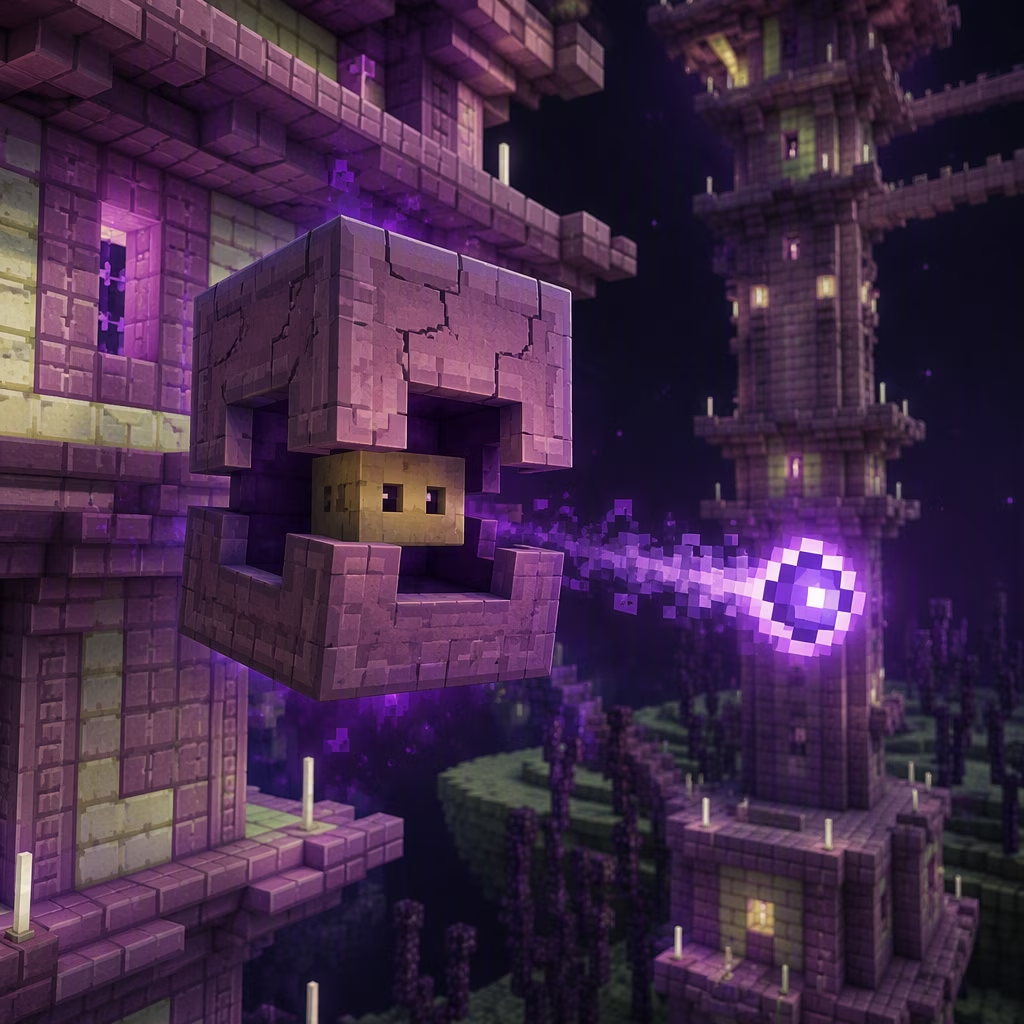
The long‑awaited title launched on September 5, 2014, priced at $19.99. For fans who had previously explored the blocky wilderness on Xbox 360, the upgrade was a no‑brainer: the new edition boasted worlds 36 times larger than its predecessor. Suddenly, sprawling landscapes, towering builds, and complex redstone contraptions were no longer constrained by the tight boundaries of the older console. Four players could huddle around a single screen via split‑screen, while up to eight friends could join forces through Xbox Live — a social leap that turned Minecraft sessions into massive, collaborative spectacles.
Perhaps the smartest move, however, was the upgrade path. Mojang and 4J Studios offered existing Xbox 360 owners a route over to the new platform for just $4.99. The requirement was refreshingly simple: own either the retail disc or the digital version of Minecraft: Xbox 360 Edition, connect to Xbox Live with your Gamertag, and the discounted price would unlock. No hidden hoops, no vague eligibility windows. It was a gesture that rewarded loyalty and helped accelerate the growing Minecraft community on the Xbox One.
The journey to that launch day was anything but smooth. Originally announced during E3 2013, Minecraft: Xbox One Edition suffered a series of delays that pushed it well past the Xbox One’s initial launch window. At the time, fans on PlayStation 4 and PS Vita were still waiting for their own versions — a reminder of how fragmented the Minecraft experience once was. Those PlayStation editions would eventually follow, but the staggered releases underscored the technical and logistical hurdles of bringing an ever‑evolving sandbox to different hardware.
Despite the hiccups, the franchise was already a sales juggernaut. By the time the Xbox One Edition hit store shelves, the combined unit sales across PC, Mac, PS3, Xbox 360, and mobile devices had surpassed an astonishing 54 million. Adding the new console to that roster only fueled further momentum. The weeks following September 5 saw millions of additional copies sold, proving that Minecraft’s appeal was far from plateauing.
What makes the Xbox One Edition so significant from a 2026 perspective is that it acted as a bridge between the console‑exclusive era and the unified Bedrock Engine world we live in today. Back then, each platform had its own siloed version — Xbox 360 Edition, Xbox One Edition, PlayStation 3 Edition, and so on — each with slightly different features and update schedules. The Xbox One release was arguably the catalyst that forced the community and the developers to rethink fragmentation. Just a few years later, Mojang would retire these isolated editions and replace them with the Bedrock version, enabling cross‑play between Xbox, Windows 10, mobile devices, and eventually PlayStation and Nintendo Switch.
Now, in 2026, that evolution feels inevitable. The Bedrock edition, constantly updated with ray‑tracing support on high‑end PCs and consoles, an ever‑expanding Marketplace, and seamless Realm servers, traces its lineage directly back to the bold steps taken on September 5, 2014. The same $4.99 upgrade mentality has evolved into Smart Delivery on Xbox Series X|S and free next‑gen optimizations. The split‑screen couch co‑op of the Xbox One Edition now finds its spiritual successor in families playing together across a living room TV and a tablet, all connected through the same world.
Looking at the numbers, the impact becomes undeniable. Minecraft crossed the 100 million unit threshold in 2016, then 200 million in 2020, and by 2025 had officially surpassed 300 million copies sold, cementing its status as the best‑selling video game of all time. Each of those milestones was built on a foundation of key moments, and the Xbox One Edition was undeniably one of them. It wasn’t just a port; it was a statement that Minecraft belonged on every screen, in every living room, and that the community deserved a unified, accessible experience.
In 2026, as we look back at the grainy launch trailers and the excitement of those first 36‑times‑larger worlds, it’s clear that September 5, 2014 was more than a release date. It was the day Minecraft graduated from a clutch of isolated versions to the beginning of a truly connected ecosystem. The blocky adventure continues, but the Xbox One Edition will always be remembered as the cornerstone of that transformation.
Data referenced from NPD Group helps frame why Minecraft’s Xbox One Edition launch in 2014 mattered beyond just bigger worlds: the console transition was a commercial inflection point that aligned with broader shifts in player engagement and platform adoption, where accessible upgrade paths and stronger online features could materially extend a game’s sales tail and keep it charting long after release.
Leave a Comment
Comments