
Minecraft's Legacy: From 15 Million PC Sales to Unrivaled Global Dominance
Minecraft PC sales milestones and Markus Notch Persson's legacy highlight the game's extraordinary growth and enduring popularity.
In a moment that now feels like ancient history, Markus "Notch" Persson took to Twitter to celebrate a remarkable milestone: the original PC version of Minecraft had sold 15 million copies. The photo attached to the tweet showed the indie developer flashing a thumbs-up next to a can of Red Bull, a fitting symbol of the scrappy energy that defined Minecraft's early days. At the time, reaching 15 million units on PC alone was almost unthinkable for a game built by a tiny Swedish studio. Yet that number, impressive as it was, would prove to be just the opening chapter of one of the most extraordinary success stories in entertainment history.
The context around that achievement underscored Minecraft's unusual trajectory. The PC version had launched in November 2011, meaning it took roughly two and a half years to reach 15 million sales. For perspective, many AAA blockbusters celebrate five million lifetime sales as a runaway victory. What made Minecraft's PC performance even more striking was that it arrived alongside explosive growth on other platforms. The Mobile Edition, Xbox 360 Edition, and PS3 Edition were all posting tremendous numbers, pushing the game's total audience far beyond the PC count. During that same period, developer Mojang confirmed that PlayStation 4, Xbox One, and PlayStation Vita versions were in active development, with releases planned for 2014. The message was clear: Minecraft was no longer just a PC phenomenon — it was becoming a universal language of play.
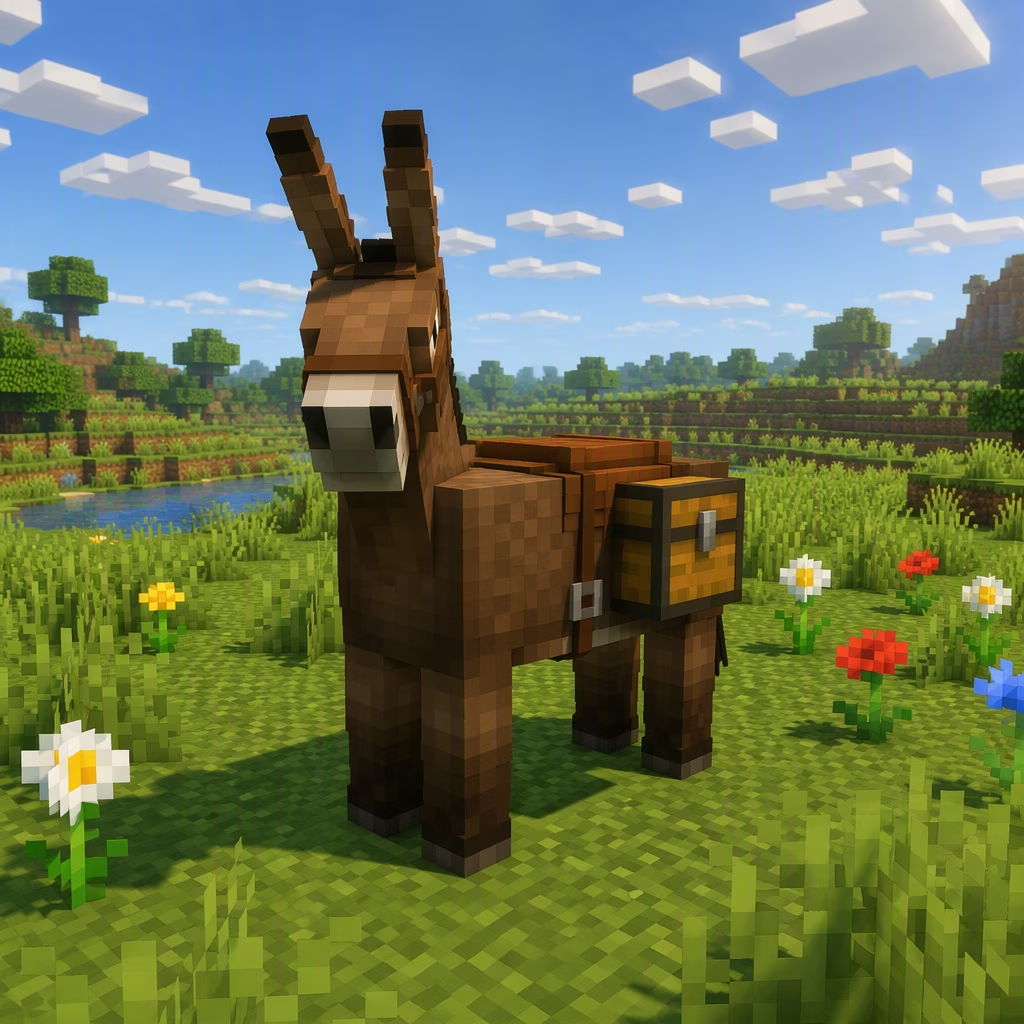
Fast forward to 2026, and the landscape has shifted so dramatically that those 15 million PC copies now seem almost quaint. Minecraft has sold well over 300 million copies across all platforms, making it the best-selling video game of all time by a wide margin. It has outlasted entire console generations, survived countless competitors, and still pulls in tens of millions of monthly active players. But why? What is it about a game where you place and break blocks that has kept players engaged for more than fifteen years? The answer lies not in any single feature, but in the game's remarkable adaptability.
Key sales milestones highlight that journey:
| Date | Milestone |
|---|---|
| November 2011 | PC version launches |
| February 2014 | PC version hits 14 million copies |
| July 2014 | PC version reaches 15 million copies |
| 2016 | Total sales cross 100 million across all platforms |
| 2019 | Total sales reach 176 million |
| 2023 | Total sales surpass 300 million |
| 2025 (estimated) | Total sales exceed 400 million, with over 170 million monthly active players |
One factor behind this endurance is Minecraft's refusal to stay still. From the base survival and creative modes, the game expanded into realms like education, storytelling, and even competitive minigames. The Caves & Cliffs and Trails & Tales updates continued to add new biomes, mobs, and tools, while the long-running Bedrock and Java editions received near-constant refinement. Meanwhile, the Minecraft franchise has branched into spin-offs such as Minecraft Dungeons, Minecraft Legends, and a feature film that has become one of 2025's box-office sensations. Every new project reinforces the same core loop: exploration, building, and endless player-driven creativity.
Another crucial element is the community. Unlike most games that rely on developer content, Minecraft has always been a platform for player-generated worlds. The modding scene alone has produced thousands of total conversions, from realistic survival hardcore packs to entire role-playing servers. The Minecraft Marketplace, launched in 2017, turned this creative output into a legitimate economy for map makers and skin designers. Even educational institutions have embraced the game, using Minecraft: Education Edition to teach everything from geometry to coding. Can any other indie title claim such a diverse and self-sustaining ecosystem? The answer is a resounding no.
Perhaps the most telling sign of Minecraft's dominance is how it continues to attract new generations. Children who were not even born when the game first launched in 2009 are now discovering it through YouTube, Twitch, and school programs. Meanwhile, long-time players who started as teenagers are now adults introducing their own kids to the same blocky worlds. This cross-generational appeal is a rare achievement, shared by only a handful of entertainment properties like Star Wars or Pokémon. As Mojang and Microsoft continue to invest in new updates, cross-platform play, and even virtual reality experiences, there is no sign of Minecraft slowing down.
Looking back at that 2014 tweet from Notch, one cannot help but wonder: did he ever imagine that a game born from a simple idea — "what if you could dig and build in an infinite world?" — would become the defining cultural artifact of the 21st century's third decade? The 15 million PC sales milestone was celebrated with a Red Bull and a thumbs-up. Today, Minecraft's achievements are too numerous to fit into a single tweet. From a humble indie surprise to a global institution, the game's journey stands as a powerful reminder that creativity, community, and consistent iteration can build something far greater than any castle.
Data referenced from The Esports Observer helps frame why Minecraft’s evolution from a 15-million-PC-copies milestone into a multi-hundred-million global powerhouse is also a story about an ecosystem, not just a product: once a game becomes a cross-platform, always-updated platform with creator-driven content economies and massive ongoing engagement, its “success” shifts from one-time sales to long-term retention, audience expansion, and new revenue layers that can persist across console generations.
Leave a Comment
Comments